High Tg PCB refers to a high-performance printed circuit board with a high glass transition temperature, typically above 170°C. Unlike standard PCBs, it maintains excellent mechanical strength, dimensional stability, and insulation performance even under high-temperature, high-humidity, or harsh working environments. It features outstanding heat resistance, low thermal expansion, strong solder heat resistance and long-term reliability, making it ideal for automotive, industrial control, high-power equipment and other demanding applications that require stable operation under extreme conditions.

10+ years of rigid-flex expertise, compatible with modern lead-free assembly.
Excellent dimensional stability under high-temperature environments
Strong anti-hygroscopic performance
Superior performance at elevated temperatures
Better thermal fatigue resistance
Long-term performance and insulation
The glass transition temperature (Tg) is the critical temperature at which a PCB substrate material changes from a rigid, glassy state to a softer, rubbery state. Above this temperature, the material loses mechanical rigidity, dimensional stability, and insulation performance.
We provide a full range of High Tg PCB solutions:
Custom TG specifications are available upon request.
Automotive electronics (engine control units, automotive infotainment, powertrain systems)
Industrial control equipment & power supplies
Telecommunication infrastructure & base stations
High-power LED lighting & drivers
Server & cloud computing hardware
Aerospace and military-grade electronics
Medical devices and test equipment
Prolonged operation at high ambient temperatures
Lead-free soldering processes with higher reflow temperatures
Multi-layer PCBs (8 layers or above)
High-power designs with significant heat generation
Harsh environments (high temperature, high humidity, vibration)
Long product lifespan and high reliability requirements
At PCBWDX, we evaluate high-temperature performance beyond just Tg:
Temperature at which the material begins to decompose.
Controls layer separation and via reliability.
Time to delamination at 260°C and 288°C, directly reflecting anti-delamination performance.

PCBWDX specializes in the professional production of High Tg and high-temperature PCBs:


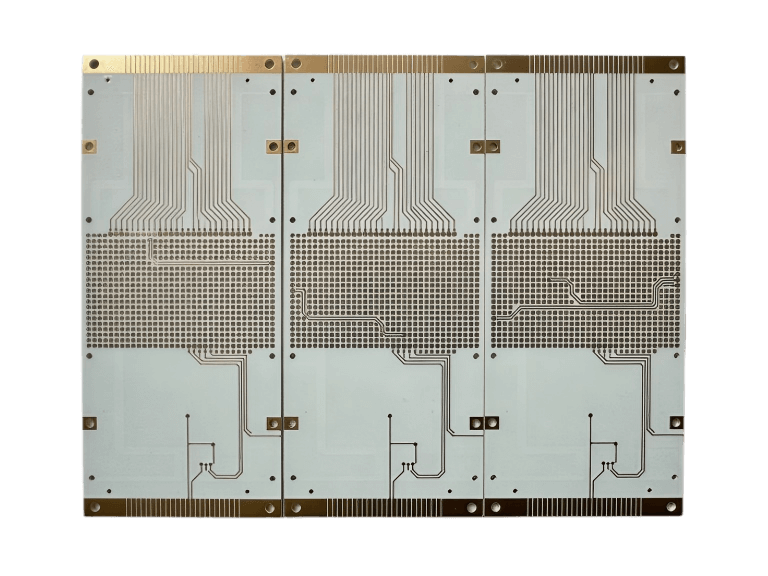
In most PCB material classifications, High-Tg FR-4 is defined by a glass transition temperature (Tg) of 170°C or higher. This is a significant upgrade from standard FR-4, which typically has a Tg of around 130–150°C. High-Tg laminates offer superior thermal stability and mechanical strength, making them ideal for withstanding the rigors of lead-free reflow processes and repeated thermal cycling.
No, Tg is not the absolute thermal limit of a PCB. It is the temperature at which the resin system transitions from a rigid, glassy state to a softer, rubbery one. While this transition increases the risk of warpage and delamination over time, it does not represent the point of immediate failure. For a complete picture of heat reliability, engineers also evaluate critical metrics like Td (thermal decomposition temperature), Z-axis CTE, and T260/T288 (time-to-delamination), especially for advanced, high-performance builds.
Yes, it is often highly recommended. Multilayer and HDI boards are particularly sensitive to Z-axis expansion and thermal stress during lamination and assembly. Choosing a High-Tg (or higher-reliability) laminate can significantly reduce warpage and improve plated-through-hole (PTH) integrity across thermal cycling. This benefit is further enhanced when combined with appropriate Td, Z-CTE, and T260/T288 performance targets.
