Years of experience
Layer capability
Certified
——What is PCB manufacturing?
PCB manufacturing is the complete process of solidifying a designed electronic circuit onto an insulating substrate — turning raw material into the finished carrier that lets resistors, chips and capacitors connect and work reliably.
Every device you can name, from a smartphone to an aerospace satellite, depends on it. PCB manufacturing is the step that turns an abstract circuit design into a physical, testable board.
Raw material & substrate prep (laminate, copper foil)
Layer imaging, etching & lamination
Drilling, plating & solder mask
Surface finish, E-test & final inspection
“A PCB is just a green board with lines on it — why do I need to choose a type?”
A board’s structure, layer count, copper thickness and base material decide what it can handle. The same copper-clad laminate can’t carry 20 A of current and also transmit 5 GHz signals cleanly. Choosing the wrong type leads to overheating, signal loss, or boards that warp in production.
——Specialized PCB Projects
Twelve board families, grouped by what actually defines them. One board can belong to several groups at once — a High-Tg board is still an FR-4 laminate, and an HDI board is still a multilayer board.
PCBs classified by mechanical form, covering rigid, flexible and rigid-flex constructions to adapt to diverse installation and space-limited scenarios.

Rigid solid substrate delivers stable mechanical support and reliable electrical performance, widely adopted for consumer electronics, industrial control and automotive electronics.

Bendable polyimide base allows 3D routing in confined spaces, well-suited for camera modules, wearable electronics and foldable consumer products.

Integrated rigid and flexible sections eliminate extra connectors, ideal for high-reliability medical equipment, aerospace and compact wearable systems.
PCBs defined by stack-up and routing density, supporting complex circuits, high-speed signals and miniaturized layouts.

Features fine traces and microvias to boost routing density, supports compact high-speed circuits for smartphones, mini sensors and portable communication devices.

Supports multi-layer routing and offers excellent signal isolation and anti-interference performance, meeting the requirements for the integration of complex circuit systems.
PCBs customized with special copper thickness, mainly engineered for high-current transmission and improved thermal dissipation.

Heavy copper material has strong current-carrying capacity, excellent heat dissipation performance, and high temperature resistance, and is suitable for stable operation of high-power electronic devices.
PCBs built on different dielectric substrates, selecting materials according to heat resistance, thermal conductivity and frequency performance.

Standard glass epoxy substrate balances cost, mechanical strength and insulation, serving as the mainstream option for most general electronic circuit projects.

High glass-transition FR-4 resists deformation under repeated thermal cycling, fits automotive electronics, power supplies and equipment with frequent temperature shifts.

Rapid thermal conductivity of aluminum substrates delivers far superior heat dissipation compared to traditional substrates, ensuring long-term operation of high-temperature devices like LEDs.

Low transmission loss at high frequencies, high signal fidelity, and strong interference resistance make it ideal for high-frequency electronics in communications, radar, and similar applications.
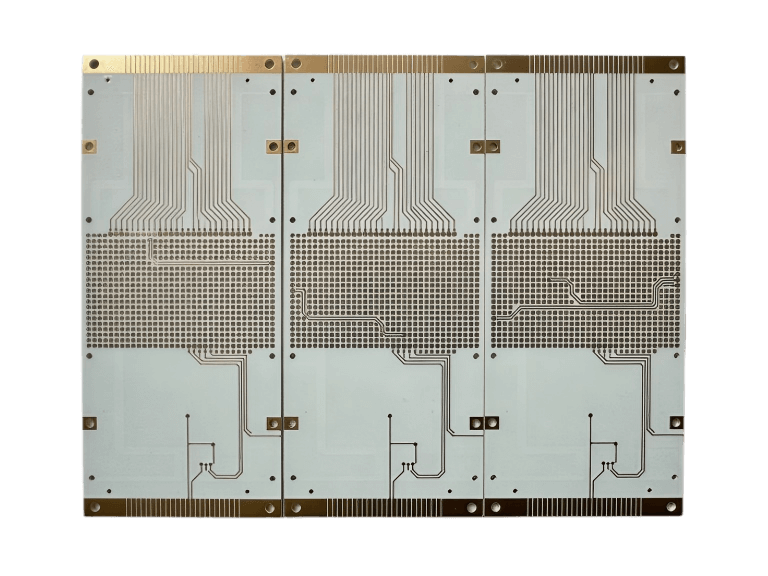
Ultra-high thermal conductivity and low thermal expansion maintain stable operation, designed for high-power laser modules, semiconductor and RF power amplifier units.
A precision tool that supports assembly — not a board itself, but essential to production quality.

Precision metal template enables consistent solder paste deposition, supporting accurate SMT assembly for all types of printed circuit boards.
—— How to choose
A quick decision path for engineers and buyers — not every project needs the most expensive board.
Flat and high-volume? Rigid. Foldable or moving parts? Flex or Rigid-Flex. No space for connectors? Rigid-Flex integrates them away.
High current needs Heavy Copper; high heat needs Aluminum or Ceramic; repeated thermal cycling needs High-Tg; high speed needs High Frequency.
Simple control? 2-layer. Dense or high-speed? Multilayer. Minimum footprint with fine vias? HDI. Tell us your specs — we'll flag what fits.
—— Core Product Advantages
A direct comparison of core features and where each board type earns its keep.
| Product Type | Core Features | Typical Applications |
| Rigid PCB | Stable structure, cost-effective, 2–40 layers, flexible routing density | Smartphones, laptops, routers, industrial control boards |
| Flexible PCB | Bendable, lightweight, vibration-resistant, 3D mounting, space-saving | Foldable phones, smartwatches, automotive sensors, medical wearables |
| Rigid Flex PCB | Rigid stability + flex bendability, integrated routing for complex structures | Drones, camera modules, automotive ECUs, aerospace equipment |
| Multilayer PCB | Multiple stacked layers, excellent signal isolation and anti-interference | Motherboards, servers, complex communication hardware |
| HDIPCB | Micro blind/buried vias, line/space to 50μm, high-density integration | Flagship phones, premium tablets, medical imaging, AI chip carriers |
| Heavy Copper PCB | 1–20 oz copper, high current-carrying capacity, low line loss, high strength | EV BMS, charging stations, industrial inverters, high-voltage supplies |
| FR-4 PCB | Standard glass epoxy, balanced cost, strength and insulation | General-purpose electronics across most industries |
| High-Tg PCB | Tg ≥150°C, heat and moisture resistant, stable in harsh conditions | Automotive electronics, industrial control, outdoor communications |
| Aluminum PCB | Thermal conductivity 1.0–8.0 W/m·K, superior heat dissipation, high strength | LED lighting, power modules, inverters, power amplifiers |
| Ceramic PCB | Resists 1000°C+, excellent thermal conductivity and insulation | Laser equipment, power semiconductors, aerospace high-temp parts |
| High Frequency PCB | Rogers/PTFE substrates, stable Dk, minimal signal attenuation | 5G base stations, RF antennas, satellite comms, radar systems |
| PCB Stencil | Laser-cut precision apertures, consistent solder paste deposition | SMT assembly of all PCB types |
Need a mixed spec — say, a Heavy Copper Aluminum PCB, or a High-Tg HDI board? Those are combinations, not separate types. We build them to your stack-up.
—— Why PCBWDX
Design, fabrication and assembly under one roof — so the board that ships is the board you designed, tested, and approved.
Specialist manufacturer with long production and quality history.
Compliant materials and processes for global shipping.
From component sourcing to SMT, wave soldering and functional testing.
We review your layout for manufacturability before production.
